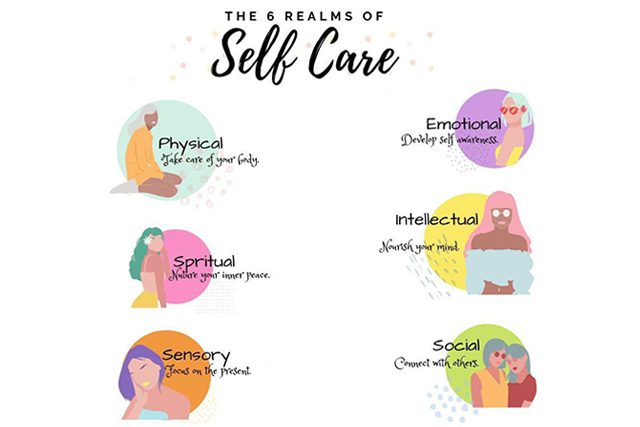
Sometimes, you may feel some challenges in your life. To overcome them you need to put in some extra effort. In this situation, you recognize the need for self-care. Self-care is listening to your body, checking in on your moments, intentionally tuning into the thoughts going on in your mind, and challenging your behaviors and belief systems if you feel that things are going out of alignment in your life. So, adopting a self-care practice that can improve your life, here we have listed five approaches you can follow:
5-Step Process for Creating and Getting Into a Self-Care Routine
Follow these five steps to create and get into self-care practice:
Find what makes you feel centered.
Gill Lopez, who organizes self-care workshops for students, professional groups, and community groups, exposes participants to different types of self-care because one size doesn’t fit all. She said that she has gone through different types of things that may appeal to people in hopes that they will find something to do routinely. So, do something which brings you joy on a regular basis, whether it is playing, listening to music, or anything else.
Brainstorm to incorporate those things into your daily life.
You can do your interesting activities in the background, or you can make more central space for your daily routine activities. Starting doing your activities for a small time may make the habit easier to get into, so try adding just one new self-care routine at a time.
Set goals for including self-care behaviors every day.
Now, once you choose the self-care routine you like to integrate into your life, set a goal on how often and when to do it. Make your goal realistic and measurable. For example, if you’re trying to disconnect yourself from electronic devices to be more present, start with a short period of time. When you successfully stick to that period of time for a week, you can set a more challenging goal.
Find support.
To keep your self-care practices regular and fun, Freitag suggests relying on your support system. Find people who engage in the same self-care activities so you can perform them better together.
Change and adjust your approach as you go.
If there are difficulties along the way, that’s okay. Ellen K. Baker, Ph.D., a psychologist with a practice in Washington, DC, says that “we’re talking about a practice, trial, and error, and our needs evolving through time.” “What may constitute self-care at one time may not be at another time.” Self-care techniques that are simple to follow include reading a book to your child (or to yourself) each night, going for a 10-minute stroll outside, getting to bed early, turning off your electronics in the evening, cooking with healthier ingredients, and surrounding yourself with cheerful things.
Final Words
By giving time to the activities which give you healthy habits and routines, you’ll be better placed to handle life’s ups and downs. So, remember that everyone deserves self-care. And the bonus is, that the better your self-care, the better you can take care of others.
Epitomizing a positive attitude, Find the Upside of the Down Times provides advice for turning bad situations into opportunities.
If you’ve ever been through tough times and wondered why it happened to you, you might have been comforted by Rabbi Harold Kushner’s When Bad Things Happen to Good People (First Anchor Books, 1981). Turn your bad experiences into good ones! Rob Pennington, MD (Resource International, 2011) is a perfect complement to Kushner.
Kushner helps questioners suffering through tragic events that seem patently unfair to those who have done their best to live good lives. Where Kushner does an excellent job of assisting people in dealing with the “How could this happen to me?” question, Pennington ignores that aspect and focuses instead on how to make the most of the cards you are dealt. He doesn’t minimize the impact of adverse events but chooses to focus instead on how to move forward despite them.
A Positive Attitude Strategy
The tone of Find the Upside of the Down Times is clear from Pennington’s opening sentence of chapter 1: “I was shot in the center of the chest by an unknown assailant…It was one of the best things that ever happened to me.” Is this man insane? How can being shot be a good thing?
Pennington’s theme can best be summed up this way: Stuff happens to us all. Some of it is terrible, but stop whining and get on with your life. It is not a direct quote but seems to be his theme as he repeatedly points out that positive opportunities always exist, despite the overwhelming nature of a problem. But, of course, you must be looking for them to find positive possibilities, and Pennington provides many suggestions.
Rob Pennington
What are Pennington’s qualifications for giving such advice? Aside from his Ph.D. in psychology, his personal experiences include: Being shot in the chest; Facing a thirty-six thousand dollar hospital bill without medical insurance; Being divorced by his first wife; Being fired; Being threatened with divorce by his second wife; Becoming the caregiver for his second wife when she becomes incurably ill with MS.
The reader might suspect the author suffers from acute Pollyannaish symptoms—being in severe denial of the terrible situations he faced. But Pennington isn’t advocating ignoring a tragedy by calling it a chance; He means we should accept negative occurrences without concentrating on them, then move on to constructive behaviors like seeking out and seizing new possibilities.
He sums up that philosophy this way: “It is a lot easier to get out of a rut if you look for a way out than if all you think about is what won’t work.”
Among the many tidbits of advice for dealing with adversity are tips for:
Reducing everyday stresses like lengthy queues and traffic bottlenecks.
A three-step process for finding a positive possibility in an adverse event.
Stress as a signal for transformation.
A five-step process for taking proactive action to change a negative circumstance.
A preference versus requirement process for dealing with relationship issues.
Dealing with the Stress of Bad Things
Find the Good in Bad Times is not only filled with excellent advice for those facing adverse situations, but it’s also an exciting recounting of one man’s way of dealing with life situations most of us fear but never have to face.
Though Pollyannaish might seem to focus on opportunities within tragic events, the strategies are fundamentally sound and consistent with advice from positive psychologists’ research.
Learn the definition of fear and how fear is the number one obstacle to individuals striving to achieve success.
“Fear is the mind-killer,” Frank Herbert said. A coward dies several times before he dies,” while “the valiant dies just once.” Rev. Edward Kirkpatrick says that “God cannot help you unless you have faith, and the Devil cannot touch you unless you have fear.” It is very accurate. It is best to think of fear as a karmic death nail. Fear of any kind is a lack of faith and a lack of confidence, and both are deadly.
Since we know fear is a bad thing, we have many euphemisms for it. We prefer to call it anxiety, dread, worry, concern, or fretting, but these experiences are rooted in fear. So the important thing is to stop excusing your fear and get rid of it.
What is Fear?
Fear may be best understood as an entity. It is a separate being that lives in your mind and the minds of others. It feeds on your thoughts and, in turn, regurgitates those thoughts as something other than, and worse than, the initial concerns you may have had. Where does the entity come from? You make it! You create it with the power of your mind. You have created your own worst enemy, and now you must best it. It takes knowledge and passion, but the ability can be learned, and the power is available.
Fear can be palpable. You wrestle with it in the dark, in dreams, and the recesses of your subconscious. For example, you may wrestle with fear when you have to speak in public, apply for a job, face someone you aren’t comfortable with or do something new for the first time.
Sometimes fear seems to take form and whip you quicker than any bully on the playground. But unfortunately, fear is the tool of all playground bullies. Without fear, a bully is powerless.
In adult life, bullies are anything that keeps you from your goal or keeps you from being happy by inducing fear. Thus there are many bullies in life. Humans often intimidate each other, either knowingly or unknowingly. Circumstances seem to bully and often feel inescapable. Worst of all is the inner bullies. Inner bullies are those voices you have allowed yourself to remember whenever you feel self-doubt.
Fear of Failure as an Inner Voice
The record of every time you ever felt that you failed or did less than your best resides in your head as a voice. Often, parents, teachers, friends, and grade-school classmates were the first to point out your shortcomings, and their condemning voices are now a part of your psychological makeup. It is silly to think of these people, many of whom are insignificant to us now, still torture us for things we had done when we were so much younger, yet we all still feel like that same kid who lost their homework in third grade, left our math book in the rain, or perhaps didn’t dress like the other children.
You hear a voice in your brain saying you’re inadequate. What could you accomplish if you could silence these voices and think things out in a fresh way, based not on the past but upon the eternal now? Who would you become if you realized that you are new to change every day? You can become whatever you wish at any moment as an act of your will. You are not stuck in your old pattern of thinking and being. Now realize that you remove the power from these bullies by taking out the fear factor. Those of courage can overcome all the bullies. You can develop that kind of courage.
Keys to Success Series, this article discusses the obstacles to change and how to overcome those obstacles under duress.
Evoking Change in Adversity
Life has a way of pressing people down and locking them into a pattern of behavior that makes it impossible to win. They are pushing too hard, trying to break even to focus on any goal. As a result, they become too weak, busy, and numb to make changes. They feel forced to keep things going the way they are. It is hard to improve anything when it’s all you can do to keep functioning. (You can’t repair your automobile while traveling at 80 mph.)
You are never in a hurry to check the road map.
Another point about going eighty miles an hour down the road non-stop is that you might run out of gas. Burnout comes to the best of us. Take a break to re-energize. Check the roadmap. Think about where you are going. When we are in a hurry, we waste time going in the wrong direction or have traffic accidents. We need to calm down and reflect.
Those who live life frantic to achieve their goals have their rewards. Well-placed ambition has its merits; however, you are headed for disaster if you get too desperate. It is good to pace yourself and take a little time to smell the flowers once in a while. Also, the more you do, the more you need to plan carefully. Avoid frantic and repetitive actions; try to find a better way.
Often attitude can make all the difference between calm success and a frantic nightmare of jumbled actions that could have been done more efficiently and with less effort. Taking the time to do a little inventory may be just what you need. Perhaps you are spinning your wheels a bit. Take stock of your life. See if you can order your life in a new and creative way. Removing the drama, fear, and pain will give you more time for productive and benevolent pursuits.
Learn to ignore nonproductive criticism
Discouragement often comes from those we love most. Whenever a great idea is discussed, someone is there to point out how impossible it is. How simple it is for them to condemn people who want to innovate. It is easy for them to sit back and laugh at others who are trying while resting on their laurels.
A difficult task to do when trying to change is to ignore the naysayer. There will be many in life. One must rise above the crowd to reach one’s potential. Ask yourself when someone criticizes you for your goals, what their goals are and how they have accomplished them. If someone is an expert in your field and has many accomplishments, perhaps you should hear them out. Maybe they will have suggestions and constructive criticism, but don’t let anyone steal your dreams. Keep trying. Until then, keep going. Don’t let the voices of those who don’t believe stop you. Go for it. Learning to ignore negativity is a learned skill. It takes knowledge and practice. We will learn more about this in the following courses.
Most importantly, you can become victorious over your inner bullies, the ultimate naysayers. More than anyone, your inner bullies know your weak points. They will be so shocked when your weak points aren’t there to pick anymore. Once you remove the pain from your past and realize that the old you don’t exist anymore and that you are a new creature moment by moment, they can’t hold you down anymore. It will work on human naysayers too.
Succeeding Series, this article discusses the obstacles to change and how to overcome those obstacles.
Why Not Change?
Change sometimes seems like too much effort. We are not as unhappy with things the way they are as they would be if we had to work hard changing them. When items become rough, people who feel this way typically quit up! “Easier said than done,” I think.
Sometimes we can’t decide what we want anyway. We’re at a loss. We know that we could be happier, but we aren’t sure what we want to accomplish. When it comes to it, we realize that we lack the wisdom and guidance to make the choices required for change.
Avoid Busy Work and Develop a Creative Plan
Hard work has a way of not sounding too appealing! Sure, you will have to work hard to make a change, but chances are you are working hard now! So much busy work! Busy work is what the teachers used to give you in school when they wanted to go to the teacher’s lounge to smoke and drink coffee. Remember those assignments of 25 sentences that you had to copy verbatim and add punctuation? Did these exercises help you, or were they more for the teacher’s advantage? Wouldn’t you have learned more about writing your sentences and doing less copy work? Sure it would have been better, but the teacher would have had to pay attention when she graded that.
Life is always waiting to provide more busy work for those likely to get in trouble if left idle. Habits die hard. Are you still giving yourself busy work, or are you operating at your true creative potential. There are many ways to do things. If you make your mind work for you and not against you, you will have plenty of time to be creative. You will save work by making the right changes in your life. Your career will be more rewarding, and your thoughts will finally be your own to do with as you will.
That said, hard work still has its place. The difference is that your hard work will be rewarded using creativity, and most of it will be a labor of love. In addition, you will learn to enjoy your work, no matter what it is, because you will realize that the “right” kind of work moves you closer to your goals.
Making Decisions
Decisions are hard sometimes. You may need to get the guidance, divine and/or human. You may need to do research, but decisions have to be made if you want to live life to its fullest. Yes, if you make sensible choices, you can improve your life. Decisions should not be taken lightly or made on a whim, but if you don’t make a choice, there will be detailed factors that will choose for you. Isn’t it better to have a choice in your life than allow things to happen to you? Recognize your preferences. Consider your options carefully. Don’t just let life happen to you. Taking conscious action today may save you a lot of heartaches. Pray for guidance, seek advice, research, and make an intelligent choice not based on fear or apathy. You’ll be happy.
Your Success is Your Fault.
If you don’t value your own life to try to make the right decisions to improve it, no one else will take the time to ensure that you are taken care of. You are no longer a child, and you have to make your own decisions; then, you have to accept responsibility for decisions.
I once heard a college Teacher say that students flunked out of college because they were accustomed to being nagged to do their homework. Teachers in grade school, and to a lesser extent, high school, take an active interest in their student’s work and bring poor marks to the students and sometimes their parent’s attention right away. On the other hand, college students turn in their assignments or not. No one says, “Why didn’t you do your homework?” Students fail if they don’t do it. Often a student doesn’t even realize that his marks are poor until it is too late because no one is nagging him.
All adult life is just like that. No one makes you do anything. You reap the consequences if you are irresponsible or make poor choices. You make your own choices and then have to live with them. Often you are still living with choices you made years ago.
High-Quality Decisions
Making high-quality decisions now can save you much grief in the future. Once you realize that only you can change your life and that you are responsible for yourself, you are free to make the best choices in life. Finally, you can be free of apathy, fear, and paralyzing emotions that wreck people’s lives. You can learn to be a friend to the universe and reap the benefits of having the universe love you back. Don’t miss out on life. Dare to!
Dos and Don’ts for busy Christians looking for ways to jumpstart a daily devotional routine.
Finding dedicated daily time to grow or improve their relationship with God can be challenging for Christians with a hectic schedule. If you are having a hard time jumpstarting your devotional life, here are a few dos and don’ts to help.
How to start a daily devotional while you’re busy
Do talk to family and friends who have demonstrated the ability to have a consistent daily devotional life. Perhaps you can’t match their schedule. Still, hearing the process others used to develop their routine can be a springboard for ideas. Inquire about what worked best for them. You may even be able to avoid mistakes by hearing the experiences of others.
Do look for ways to waste less time. It is the best way to get dedicated time for God in your day. Try setting time limits on the time you spend watching television and the Internet. Designate times to start and stop answering phone calls and emails. By trimming wasteful activities, you can increase the time for this new habit.
Do embrace technology as a tool. Most Christian websites, including Crosswalk.com and ChristianityToday.com, allow you to sign up for daily devotional emails. Additionally, many churches and pastors offer podcasts you can subscribe to. Finally, like most busy people, check out the app store for your service provider if you have a smartphone. There are many devotional apps for the iPhone, Blackberry, and Droid phones. According to a February report from FoxNews.com, even President Barack Obama gets a daily devotional on his Blackberry every morning.
What not to do if you are adding a daily devotional to your hectic schedule
Don’t take on too much. One day you may be able to carve out an hour each day for prayer and meditation. But, right now, you want to focus on consistently building devotional time into your day. As many Christians struggle to make time for God, several books are available to assist believers with busy lives. They range from books with non-traditional approaches such as Awake My Soul: Practical Spirituality for Busy People by Timothy Jones to books specifically for women. It is about a Mary Heart in a Martha World.There’s a book for everyone. Could you find the best one for you and try it?
Don’t limit your devotion to moments when you are entirely alone. For example, the time you spend on your commute to work, in the break room at lunch, or even at the gym can be dedicated to God. In addition, it will give you more options in building a regular devotional appointment into your schedule. In Rick Warren’s bestselling book, The Purpose DrivenLife, he writes, “Everything you do can be ‘spending time with God’ if he is invited to be a part of it and you stay aware of his presence.”
Do not surrender if you skip a day (or two.) According to The Search for Significance Devotional by Robert S. McGee, “Consistency is laudable and good, but don’t worry…The goal is to reflect on God’s truth so that it sinks deeply into our hearts and minds.” When you do get off track, figure out how and why. Then adjust your plan to get back on course. Look at the entire experience as your spiritual experiment. Success will require time and effort.
Most importantly, give yourself time to find the proper routine and resources to activate your devotional life. Your relationship with God is unique, and your devotional time with him will reflect that. Embrace the process of researching methods and trying different approaches. The reward of an enhanced relationship with God will be worth the effort.
By overcoming a fear of rejection or losing a part of who we are and accepting others, we can feel natural and accepted.
“The most dreadful poverty is loneliness and unloved.” – M.T.
When do you feel lonely? When do you feel unloved? Everybody needs to be accepted, and when this need is not met, I think most people would feel lonely and unloved, and it hurts.
How do you get the need to be accepted met? Keep in mind the following:
Everybody cannot take you; there will always be somebody unable or unwilling to take you for who you are.
Many people share the need for acceptance; you want to remember that other people’s condition is as significant as yours.
While it is important to be true to yourself, it doesn’t mean you should hold tightly onto the image you think you are or should be; you need to be flexible.
A fear-driven attitude of being ‘nice.’
Some people try to be accepted by everybody – sometimes literally – for who they are. I used to be one of the people-pleasers or an ‘approval-addict.’ Unfortunately, it won’t happen unless you become a chameleon. Dr. Harriet B. Braiker states in her book Disease to Please that “Your concerns and fears will grow as you associate with being polite rather than being authentic. It’s better to accept that conflict is inevitable and to learn to deal with it effectively.” (Braiker, 2002)
Some people try to deter negative emotions from others by being nice because if you are friendly, you’d think nobody would want to reject you. You’d assume that everybody would accept and love you for your niceness. However, you are not authentic if you give a yes to others when your heart tells you no. Could people accept you for who you are in this way? No.
Their needs are as valuable as yours.
Would changing the way you handle things deprive you of your self-identity? To get your need for acceptance met, you may sometimes become blind to others’ need to be accepted. Everybody is different. Their upbringing and past have much impact on how they react to certain situations. Naturally, when one person tries to be taken by somebody, the other person might need to adjust a part of them if the person is willing to meet your need. This process should be reciprocal. Some people from troubled backgrounds may find it too threatening because they feel “if [they] give a part of [themselves], [they] are losing it forever. . . .” (Dayton, 1997, P. 92)
The truth is we are not losing it forever. As long as we have it, we can share it without losing it. You want to be accepted, but does it mean that you should not change your attitude, outlook, actions, etc., because “it is who you are” and that you can expect others to accept it? What if everybody claimed the same? There would be no acceptance but resentment or loneliness of not being accepted.
Be flexible
Holding tightly onto who you are, you may be rejecting others, but if you don’t learn to own the sense of who you are, as Dr. Braiker says, “[Y]our hidden motivation may be to manipulate others into liking you or at least into not rejecting you.” (Braiker, 2002, p. 40)
Relationships are typically not black and white; they are usually ‘shades of gray.’ Most of you must have heard somebody tell you that you must always be who you are. But being always who you are does not mean you should be rigid with your self-identity. If you favor or even pride in your lifestyle of abstinence, while other people may accept it, they may also want to drink alcohol or smoke cigarettes. But, then, you should get their lifestyle as well. It doesn’t mean that you are being a phony by bending yourself; it only means you care about the relationships.
You can be authentic and still be accepted. However, it would help if you were original and taken without feeling guilt, insecurities, self-doubts, and loneliness.
We propose several factors and their relationships as a strategy for achieving happiness in life.
Happiness, of course, is a subjective construct. It is closely related to what one values in life. The more one receives value; the more one can expect to be happy. Alas, this simplistic perspective somehow does not ring true. Things are just not that simple. Does the question then become, what is the formula for happiness? Well, one cannot propose a procedure without exception or difference. The optimal outcome is a formula that works for most.
The Formula
Upon careful thought, this formula seems most accurate.
H = LP (I2 – (a + c))
It is not a mathematical formula. It is not a precise algebraic equation. Instead, it is a Philosophical, or perhaps even Psychological, the paradigm of life. Yet, if we live our lives understanding and employing this formula, we can expect to achieve happiness more frequently than not. Therefore, the individual factors of this formula are worth considering.
Love
The first is love (L). When we can experience love and express love, we tap into the very essence of our souls. SNo love knows no God, says the Bible; God is love” (I John 4:8). The same sense of our being is love. Real love sustains, enriches, and energizes us to maximize life. When we have a genuine love of God and each other, we can mitigate or nullify many of the obstacles or forces that would seek to destroy our happiness. The qualifier is “real” love. The answer to this is also found in Scripture. In I Corinthians 13:13, Paul defines love.
Theologians call the love we speak of here “Agape Love” (Carson, 2000). It is a selfless, sacrificial love that is unconditional. It is that love God offers us even though we are undeserving. It’s our love for one other. You must revere the Lord your God. Priority one. Second. Each commandment is hung on these two (Matthew 22:37-40)
Purpose
The second factor is purpose. The purpose is the end to which we seek to obtain in life. It is the primary purpose of and for a person’s life. It is your calling in life. It is that thing to which we dedicate our effort and our thought. It answers the questions of why, and for what, where you created. It includes our goals and objectives.
We mark it by our milestones and progress steps. It reflects our values and our core life vision. Finally, our contribution to the world is answered. When one has a purpose, one will have drive. Drive is that quality that enables us to rise every day and persevere despite mammoth adversity (Frankl, 2006). Without purpose, one exists and reacts to every shift in life—those with a clear sense of purpose experience life on their terms. For them, it ideally provides meaning. Meaning gives importance to one’s life.
Relationships
The following few factors focus on one in their existence among others. We consider these factors to confine one’s community and hence the parenthesis. The first of these factors is the “I” factor. This factor represents a relationship. There are two dimensions of the “I” factor: intrapersonal and interpersonal relationships. Both are essential and dynamic (Vohs & Finkel, 2006). We measure their significance by squaring (or multiplying each against the other) the dimensions.
Intrapersonal Relationship
The intrapersonal relationship is the relationship we have with ourselves. When we love ourselves, we enjoy positive intrapersonal relationships. When we have an appropriate sense of ego strength, we can develop positive self-love. With positive self-love, we can have a strong sense of resilience which empowers us to withstand the assaults of life.
When we love ourselves, we have a sense of autonomy and integrity that is not dependent or determined by others. Yet, it enables us to love others more deeply. We can develop boundaries and a sense of ethics that structure our purpose in life with self-love.
Interpersonal Relationships
The other dimension of the “I” factor in interpersonal relationships. It is our relationship with others. When we enjoy positive relationships with others, our need for companionship and social interaction is satisfied. Biologically, humans seek social connections. We do not do well in isolation. We are enriched, rewarded, and personally enhanced by finding positive relationships. Our relationships within the community develop the others factors in our equation.
As we interact, we learn of others’ needs and our capacity to meet these needs. It, then, forms our purpose. Continued isolation, or solitude, is harmful to our psyche and leads to all other sorts of pathology.
We square the “I” dimensions to measure our relationships accurately. When we have a high standard of “I” squared, we have balance in our lives, and most importantly, our psyches are intact. A strong “I” provides safety, which allows us to engage in the pursuit of happiness. Conversely, the low strength of “I” nullifies all of the other factors and, in turn, destroys our ability to be happy.
Threats to Relationships
There are several threats to a high measure of “I.” Perhaps none more threatening than our remaining factors of (a +c). The “a” factor is Anger. The “c” factor is Conflict. Anger is a strong emotion that may be harmful. Destructive Anger directed externally destroys Interpersonal relationships. While Anger directed internally, often called depression, destroys personal stability and capacity.
The goal, therefore, has to be to minimize the result of (a +c). In other words, to pursue and/or realize happiness, we must minimize our destructive Anger and Conflict. Scripture provides; “An angry man stirreth up strife, and a furious man aboundeth in transgression” (Proverbs 29:22). Scripture cautions, “No relationship with an angry guy, no going near a furious man, lest you learn his methods and fall into his trap (Proverbs 22:24-25).
We need to realize not all Anger is destructive; some can be pretty beneficial. The determining issue is how we express our Anger. When expressed through Conflict, we are mitigating against our ability to be happy. We have to realize there may be instances when we cannot avoid Anger and Conflict. However, we need to control the damage in those instances and open paths towards reconciliation. Holding umbrage towards others is a sure deterrent towards happiness. Learning to forgive others for their trespasses has to be a priority.
Bringing it Together
We can recognize happiness by realizing how these factors work and devise strategies to accentuate the good and avoid the bad. Therefore, the vehicle for employing this equation is the strategies we develop for living life. Happiness becomes an achievable reality when we remain aware of ourselves and work the formula.
One of the critical concepts of Aristotle’s virtue ethics is finding the mean, or balance, between excess and deficiency.
As part of Aristotle’s virtue ethics, the Doctrine of the Mean can be explained in the following manner: “Excellence in any field is achieved by hitting the mean and not by excess or deficiency. So, to be virtuous in our acts and emotions, we must avoid excess or insufficiency in our activities and feelings” (Velasquez 470).
Thus, the goal becomes finding the trait that falls between deficiency and excess. It may be applied to various characteristics in terms of caring for oneself. For example, a person may be excessively stingy and unwilling to give to anyone. On the other end, a person may be too selfless, taking care of everyone else before caring for themselves.
Locating the balance comes by sliding away from these distinct poles and coming to the middle ground. In this case, the mean may be characterized as generosity. Yet, what if selfishness became one’s goal in a refined sense of the term?
Redefining Selfishness
Codependent No More, Melody Beattie cites Nathaniel Branden: “Thus, to respect oneself is to practice selfishness in the greatest, noblest, and most misunderstood sense. And this, I would argue, requires considerable independence, boldness” (Branden in Beattie, 126).
Many people will reject this immediately upon reading it. “Be selfish? That’s ridiculous! I have kids, a family, and a company! I can’t afford my health. It wouldn’t be fair to everyone else.” In response, Beattie urges readers to realize the following: “Out of high self-esteem will come true acts of kindness and charity, not selfishness” (126). It is, in a sense, selfishness that leads to selflessness. Being honest with oneself is selfish.
Applying Aristotle’s Ethics
How does Aristotle fit into all of this? His Doctrine of the Mean encourages balance. In situations where one needs to care for themselves, it can be beneficial to examine the excess and deficiency of their actions and the mean they are striving for.
“Giving ourselves what we need does not only mean giving presents; it means doing what’s necessary to live responsibly—not an excessively responsible or an irresponsible existence” (Beattie 116). Utilizing Aristotle’s model, responsibility to others at our expense is categorized as an excess. Conversely, downright irresponsibility is a deficiency. The balance here is a responsibility to oneself.
As Beattie pointed out, caring for yourself does not necessarily mean treating yourself to lavish gifts or vacations or focusing on your own needs at the expense of everyone else. Responsibility to yourself involves realizing and acknowledging your own needs and wants, even if there is nothing you can do about them at the moment.
Being honest about your feelings and needs seems an overly simplistic way to begin practicing responsibility to yourself. Yet, sometimes the most superficial answers are ignored because they seem too easy. Unfortunately, these are often the most excellent options.
This article describes the concept of the law of attraction and discusses techniques to use in attracting that which is desired.
The law of attraction is a long-standing philosophical principle. Its general guide espouses the notion that whatever people say and think is what they attract. If they say and think negative things, then those things will materialize. However, if they believe and verbalize positive things, they will come into being. Thus, whatever people have drawn to themselves through their thoughts and words is what they have in their lives today.
How the Law of Attraction Works
Those who embrace the law of attraction believe that people will invite into their lives whatever they put their energy and focus on, whether they want it or not. For example, continually talking about debt will only bring more debt, while speaking of wealth will bring abundance. Likewise, dwelling on unhappiness attracts more sadness, while concentrating on blessings brings joy and contentment.
Applicability of the Law of Attraction
Affects every element of existence. It applies to material possessions, health, wellness, feelings, attitudes, and accomplishments. People develop their inner being by focusing on the information they bring into their minds. In relating this idea to an examination, the words “don’t fail” would focus on failure, while the words “be sure to pass” would draw attention to passing.
The Law of Attraction is used by individuals to actualize their wishes. So, for example, those who say they cannot afford a particular car will not get the car, but those who believe they can find a way to afford it will likely acquire it.
Techniques Associated with the Law of Attraction
There are some specific techniques associated with the law of attraction that people can use to create what they want in their lives. First, one must speak about what they want as if they already have it. Some people refer to this technique as telling the truth in advance. However, it should be used with excellent specificity. For example, someone who wants a new home might say, “We have a beautiful new home with four bedrooms, four bathrooms, and a gourmet kitchen with cherry wood cabinets, granite countertops, and marble flooring.”
Another helpful technique is visualization. Visualization is using the imagination to concentrate on what is desired. For example, someone who wants a brand new red sports car would create a visual image of precisely what is expected. The law of attraction espouses that the visualized particular thing will materialize.
Using Attraction to Shape the Future
People utilize the law of attraction to deliberately create what they want in their lives by focusing on the specific details and speaking as if they already have it. The power for creating comes from within. The process involves getting a clear mental image of what is desired, being excited about it, and getting very focused. That which is created in the mind will then materialize.
We use cookies to ensure that we give you the best experience on our website. If you continue to use this site we will assume that you are happy with it.